
How to increase restaurant sales: Building multiple revenue streams
Restaurants that rely on a single revenue stream are more exposed to slow periods, seasonal dips, and unexpected disruptions. Adding online ordering, delivery, click and collect, self-service kiosks, and catering gives you more ways to generate revenue from the same kitchen, team, and brand. Most of these channels also have higher average order values than walk-in trade and lower staffing costs per order.


Most restaurants start with one revenue stream: customers walk in, sit down, and order. It works until it does not. Quiet periods, seasonal dips, local competition, or any unexpected disruption can expose how fragile a single-channel operation really is.
The restaurants that grow consistently tend to have multiple ways to generate revenue from the same premises, team, and brand. Not all of these require major investment. Some can be up and running within days. Here is a practical breakdown of the options available and how to approach them.
What are restaurant revenue streams?
A revenue stream is any distinct channel through which your restaurant generates income. For most hospitality businesses, the main ones are dine-in, online delivery, click and collect, catering, and in some cases merchandise or events.
The goal is not to run all of them at once from day one. It is to understand which ones are realistic for your business model and add them in a way that does not overextend your kitchen or your team.

Revenue streams available to restaurants
Dine-in
Walk-in and pre-booked dine-in remains the primary revenue channel for most full-service restaurants. The opportunity to increase revenue here is less about adding a new channel and more about increasing average spend per cover through upselling, table ordering technology, and optimising your booking capacity.
Online ordering and delivery
Adding an online ordering system with delivery is the most significant incremental revenue stream available to most restaurants. Customers order through your branded website or app, food is prepared in your existing kitchen, and a driver delivers it directly to them.
The key distinction is owning your direct ordering channel rather than relying solely on third-party platforms. Aggregators such as Uber Eats and Deliveroo charge commissions of up to 30% per order. A branded online ordering system means you keep that margin, own the customer relationship, and retain the data you need to market to them again.
Click and collect
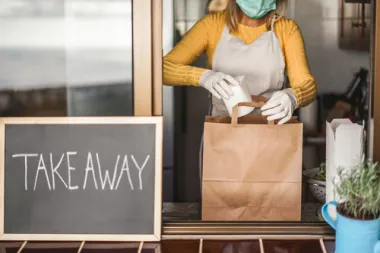
Click and collect (customers ordering online for pickup rather than delivery) is a high-margin channel. There are no delivery costs, order volumes can be high during peak periods, and customers who collect regularly tend to become loyal repeat buyers. It also has a lower barrier to entry than delivery, since you do not need to manage drivers or delivery logistics.
Self-service kiosks
Kiosks are primarily a dine-in efficiency tool, but they consistently increase average order values. Customers ordering at a kiosk spend more on average than customers ordering at a counter, partly because of better upsell prompting and partly because there is no social pressure to order quickly. Kiosks also reduce pressure on front-of-house staff during peak service.
Table ordering
Digital table ordering, where customers order from their phone or a table device without needing to flag down a server, speeds up service, reduces errors, and tends to increase average spend. It works alongside your existing dine-in operation rather than replacing it.
Catering and events
Catering for offices, private events, and corporate bookings is a separate revenue stream that uses your existing kitchen infrastructure. It typically involves larger order values, advance notice, and repeat business from the same clients. It is worth considering if your kitchen has capacity during off-peak hours.
Merchandise
A smaller but low-effort revenue stream for restaurants with a strong brand identity. Branded items such as coffee, sauces, meal kits, or apparel can be sold in-store or online. It is not a primary revenue driver for most restaurants but it extends brand reach and adds a touchpoint with loyal customers.
Why multiple revenue streams make for smart business
One interesting recent piece of research from McKinsey & Company identified digital capability as a crucial factor in the performance of restaurants during the height of the coronavirus crisis. It showed that the performance of a restaurant during the crisis depended largely on factors such as digital maturity, urbanicity, as well as the off-premises versus on-premises sales mix.
“A strong online ordering presence, digital loyalty programs, and robust customer relationship management (CRM) systems have been lifelines for restaurants during this crisis, as levels of digital engagement among consumers have soared,” reported McKinsey.
So hospitality businesses which already had a high proportion of off-premises sales were well positioned to continue generating turnover from the outset of the crisis. Those with pre-existing online food ordering systems were able to continue with pick-up and delivery operations when dine-in was literally taken off the table, maintaining sales volumes and keeping staff employed.
Digital capabilities and the capacity to pivot quickly give hospitality businesses the flexibility and adaptability to survive a crisis of such magnitude. Of course, this doesn’t mean you need to completely abandon the existing business model or values which have proved successful in the past. You can merge old and new practices, adjusting to these modern trends and challenges while maintaining your traditional brand.
A typical case of this would involve providing online food ordering with pick-up and delivery options, running side-by-side with your dine-in service. Through Flipdish delivery partners, you can integrate a last mile delivery service with our online ordering system, providing a straightforward end-to-end service and customer experience. This also means you don’t need to rely on signing up with aggregator platforms to provide a delivery service, with their high fees eating into your margins while your brand is also diminished in the process.
From a practical standpoint, with Flipdish you can integrate all your online orders directly with your point of sale (POS) system, processing all your in-store sales and online orders together. So having multiple revenue streams can still be simple and streamlined in the business operation.
The ongoing COVID-19 crisis is really proving the importance of being able to pivot and adapt by having multiple facets and services in place. It’s really all about having your options open, therefore being able to tap into different aspects and income streams. Just as this is smart practice in personal terms, the same applies to business.
There is still so much uncertainty about how society and economies will emerge from the coronavirus crisis, and there’s unfortunately always the potential for other future crises to emerge down the line. Therefore, it’s wise to have robust plans and structures in place, so you can optimise the most profitable areas at any given time.
At Flipdish, we strongly advocate a multi-faceted approach to increase sales overall and future proof your business.
Grow your sales with our online food ordering system
FAQs
Adding online ordering with click and collect is typically the fastest way to increase revenue from your existing operation. It uses your current kitchen and team, requires no additional premises, and can be set up and live within days. Delivery extends the reach further but involves more logistics to manage.
Focus on repeat orders from existing customers before trying to acquire new ones. SMS marketing, push notifications, and email to your existing customer base are low-cost and high-return. Loyalty programmes, birthday offers, and win-back campaigns for lapsed customers are all cost-effective ways to increase order frequency.
Restaurant profit margins typically range from 3% to 9% for full-service restaurants and slightly higher for fast food and delivery-only operations. Margins are sensitive to food costs, labour, and rent. Adding higher-margin revenue streams like click and collect or catering can improve overall profitability.

