
SMS marketing for restaurants to get more online orders
SMS marketing gives restaurants a direct line to customers' phones with open rates above 90% and click-through rates of around 19%, far ahead of email. It works best for time-sensitive offers, win-back campaigns, new menu announcements, and loyalty nudges. Compliance with GDPR (EU/UK) and the CAN-SPAM Act (US) is mandatory, and sending without proper consent can result in significant fines.

SMS marketing is one of the most effective and underused tools available to restaurant owners. Text messages are opened within minutes, reach customers directly on their phones, and consistently outperform email on every engagement metric that matters.
Whether you want to drive orders on a quiet Tuesday, re-engage lapsed customers, or promote a limited-time offer, a well-timed text can generate immediate results. Here's everything you need to know to do it well.
Read on to discover:
What is SMS marketing for restaurants?
The benefits of restaurant text message marketing
How to increase online orders with SMS marketing for restaurants
What is SMS marketing for restaurants?
SMS marketing for restaurants involves sending text messages to your customers to provide information and drive them towards a specific action. For example, clicking a link to your online ordering website or app, or joining your loyalty program.
Restaurant text message marketing is particularly effective because it reaches your customers right in their pockets and has high levels of engagement – especially when compared with email marketing and other forms of digital marketing for restaurants.
The benefits of SMS marketing for restaurants
With so many restaurants focusing on email marketing, social media marketing and other tactics, text message marketing isn’t always a priority – but this means consumers are ready to engage. A survey by attentive.com found that 91% of respondents were open to recieving brand comms via SMS.
The willingness of consumers to engage with brands via SMS makes it a highly impactful tool leading to a host of benefits for restaurants willing to give it a go.
High open rates
Various sources tout open rates of over 90% for SMS messages. When you consider that Hubspot says a good email open rate is 21%, the difference is astonishing. Text messages are more immediate, they are more likely to be read and they are therefore an excellent way to quickly engage with your customers.
Good engagement
Not only are text messages more likely to be opened in the first place, they also have a higher chance of getting a response or driving action. Research shows that average click-through rates (CTR), a measure of how many people take the desired action on receiving a marketing text, are around 19% for text messages, compared to just 4% for email marketing.
Low cost
Text messages are short and snappy to write and cheap to send out en-masse using text message marketing tools. That makes SMS marketing a high-impact, low-investment marketing tactic for restaurants.
SMS marketing examples for restaurants
Here are ready-to-use text message examples you can adapt for your restaurant:
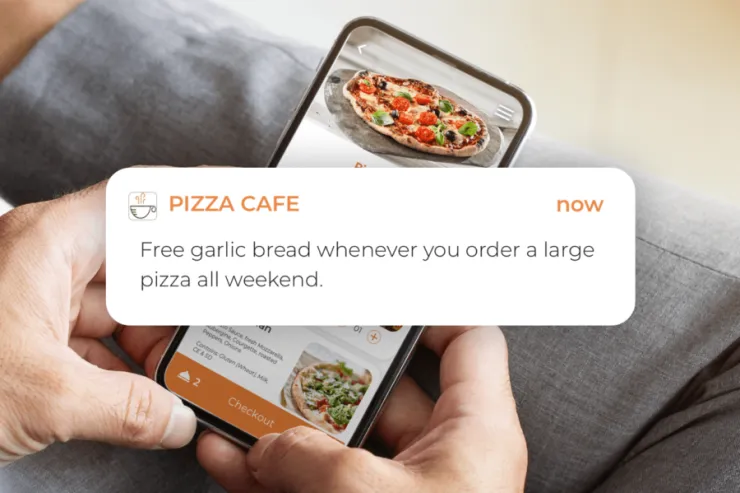
Flash offer: 🍕 Tonight only - free garlic bread with every order over $20. Order before 9pm: [link]
Win-back: We miss you! It's been a while. Here's 15% off your next order: WELCOME15 - valid this week only: [link]
New menu item: 🌮 New on the menu: Korean BBQ Tacos. Try them tonight and let us know what you think: [link]
Birthday reward: Happy Birthday [Name] 🎂 Treat yourself - here's a free dessert with your next order: BDAY25 [link]
Loyalty nudge: You're 1 order away from a free meal! Place your next order here: [link]
5 ways to increase online orders with restaurant SMS marketing
Text message marketing is a great way for restaurants to drive more online orders. After all, the customer already has phone in hand when they receive the message. So it’s just one more step to get them onto your ordering website or app.
Here are five ways to drive traffic to your online ordering site and increase online orders.
Get the timing right
Text message marketing is all about an immediate, direct response, which makes the timing of your messages all-important.
According to 2022 stats, 95% of text messages are and responded to within three minutes of being received. You don’t want to be sending out an offer for a discounted breakfast at 10pm and you don’t want to irritate customers by sending a message in the middle of the night.
By analysing your ordering data to find ordering patterns, you can determine the optimum times to send out specific offers. Friday night orders taking a slump? Send out an offer code to get your best customers re-engaged.
Keep it short and snappy
Text messages are a great way to quickly connect with your a customer right in the palm of their hand. Don’t waste the opportunity by boring them with long, dry walls of text. Get to the point, demonstrate the value on offer and make your intention clear with a call-to-action.
The customer should be able to quickly see the value of the offer and know how to take action. For example, by clicking on a link to your online ordering website or app.
Always get permission
While you want maximum impact from your SMS marketing campaigns, you also have to make sure you’re compliant with the law. European GDPR regulations and the CAN SPAM Act in US are designed to prevent unwanted messages being sent. Ensure you’re up to date with the rules in your area.
General best practice includes:
Giving customers the option to opt-out of SMS marketing
Asking permission before storing personal data
Only sending accurate and relevant information to your customers
Only sending messages during reasonable hours
Making sure customers are aware of your privacy policy and terms and conditions
Optimise your online ordering site for mobile users
There’s no point driving all this traffic to your online ordering website if it’s not optimised for mobile devices. If a customer can’t view the site properly or there are errors in the checkout process, they will quickly leave and order somewhere else.
Modern ordering websites tend to be made with mobile in mind. They are usually designed to be responsive, which means the content adapts to the type of device so the user gets the best experience possible regardless of their hardware.
For the best experience, and the best way to keep customers coming back, invest in your own branded mobile ordering app. Designed specifically for mobile users, apps give the best experience and once they are downloaded, your customers are more likely to order on your app again and again.
Appeal to emotions
It often feels like laying out a persuasive, logical argument is the best way to convince someone to take action. But time and time again, emotions have been shown to drive decision-making more than pure logic.
When you know your customers’ pain points, you can use emotional messaging to drive action and fulfil their desires with the right offer.

For example, “be part of an exclusive club and get your tenth order free” is more powerful than “join our loyalty programme for your tenth order free”.
Simple changes in the language you use can make all the difference when it comes to driving an increase in online orders.
SMS marketing compliance for restaurants
Sending marketing texts without following the rules isn't just bad practice. It can result in serious fines. Whether you're based in the US, UK, or EU, there are legal frameworks governing how you collect customer data, what you can send, and how customers can opt out.
GDPR: EU and UK
The General Data Protection Regulation (GDPR) applies to any business collecting or processing personal data from customers in the EU or UK. For SMS marketing, this means you must have a clear legal basis for contacting customers, and in most cases that means explicit opt-in consent.
There are seven core principles under GDPR that all data processing must comply with:
- Lawfulness, fairness and transparency. Customers must know what they're signing up for.
- Purpose limitation. Data collected for SMS marketing can only be used for that purpose.
- Data minimisation. Only collect what you actually need, typically name and phone number.
- Accuracy. Keep your database up to date and remove invalid numbers.
- Storage limitation. Don't hold customer data longer than necessary.
- Integrity and confidentiality. Store data securely to prevent unauthorised access.
- Accountability. You must be able to demonstrate compliance if investigated.
What this means in practice:
- Customers must actively opt in. Pre-ticked boxes or implied consent are not valid.
- Every message must include a clear, easy opt-out option (e.g. "Reply STOP to unsubscribe").
- You must have a privacy policy that explains how customer data is used.
- Customers can request their data be deleted at any time and you must comply.
- Breaches can result in fines of up to €20 million or 4% of global annual turnover, whichever is higher.
CAN-SPAM Act: United States
In the US, SMS marketing is primarily governed by the CAN-SPAM Act, enforced by the Federal Trade Commission (FTC), alongside the Telephone Consumer Protection Act (TCPA), which specifically covers text message communications.
The key requirements are:
- Written consent. You must have explicit written permission before sending any marketing texts. Verbal consent is not sufficient.
- Clear identification. Every message must clearly identify your business.
- Opt-out mechanism. Every message must include a simple way to unsubscribe (e.g. "Reply STOP").
- Honour opt-outs promptly. Once a customer opts out, you must stop messaging them within 10 business days.
- No deceptive messaging. Offers must accurately reflect the content of the message.
- Appropriate hours. Messages should only be sent during reasonable hours, generally 8am to 9pm in the recipient's local time zone.
- Age compliance. Ensure your database does not include minors.
Non-compliance with the TCPA carries statutory damages of $500 to $1,500 per individual violation, meaning a single non-compliant campaign sent to thousands of customers can result in class-action exposure running into millions.
Best practice regardless of location
Whether you're operating under GDPR, CAN-SPAM, or both, these principles apply universally:
- Always use a double opt-in. Ask customers to confirm their subscription after signing up. It reduces spam complaints and keeps your list clean and engaged.
- Make opting out frictionless. A single "STOP" reply should immediately remove a customer. Never make it harder than that.
- Keep records of consent. Document when and how each customer opted in. This is your evidence if a complaint is ever raised.
- Review your list regularly. Remove inactive numbers and anyone who hasn't engaged in over 12 months.
- Use a reputable SMS platform. A compliant SMS marketing tool will handle opt-out management, consent records, and timing rules automatically, reducing your legal exposure significantly.
Note: Regulations vary by country and are updated periodically. Always verify current requirements with your local data protection authority or a legal adviser before launching SMS campaigns.
Get more online orders with SMS marketing for restaurants
SMS marketing is a powerful tool for restaurants to engage, reengage and drive action in their customers. Hitting right in the pocket with timely and emotionally charged messaging is an easy win and a cost-effective method to drive more orders to your online ordering website or app.
But if running your business has got you busy enough, you can still take advantage of text message marketing without it taking up all your time by hiring a restaurant marketing agency. Our team of marketing experts helps our restaurant partners thrive using a combination of search engine optimisation, text message marketing and social media marketing.
FAQs
SMS marketing for restaurants involves sending promotional or informational text messages to opted-in customers. Common uses include promoting special offers, announcing new menu items, re-engaging lapsed customers, and driving traffic to an online ordering website or app.
Yes - it's one of the highest-performing marketing channels available to restaurants. Text messages have open rates above 90% and click-through rates of around 19%, compared to roughly 21% open rates and 4% CTR for email marketing.
Both reach customers on their phones, but push notifications require a branded app and only work when the customer has it installed. SMS reaches any phone number without an app. Push notifications tend to have higher engagement for active app users; SMS is broader and works for your full customer database.