
Third-party delivery services for restaurants: what they really cost you
Third-party delivery services such as Deliveroo, Uber Eats, and Just Eat give restaurants access to a large customer base, but they charge commissions of up to 30% per order and keep control of the customer relationship and data. For many restaurants, the most profitable approach is to use these marketplaces selectively for discovery while driving repeat customers to their own direct ordering channels, where there is no commission and the customer data belongs to the restaurant.

Third-party delivery marketplaces have become a default part of how many restaurants sell food online. Apps like Deliveroo, Uber Eats, and Just Eat put your restaurant in front of a large, ready audience, and for discovery that has real value.
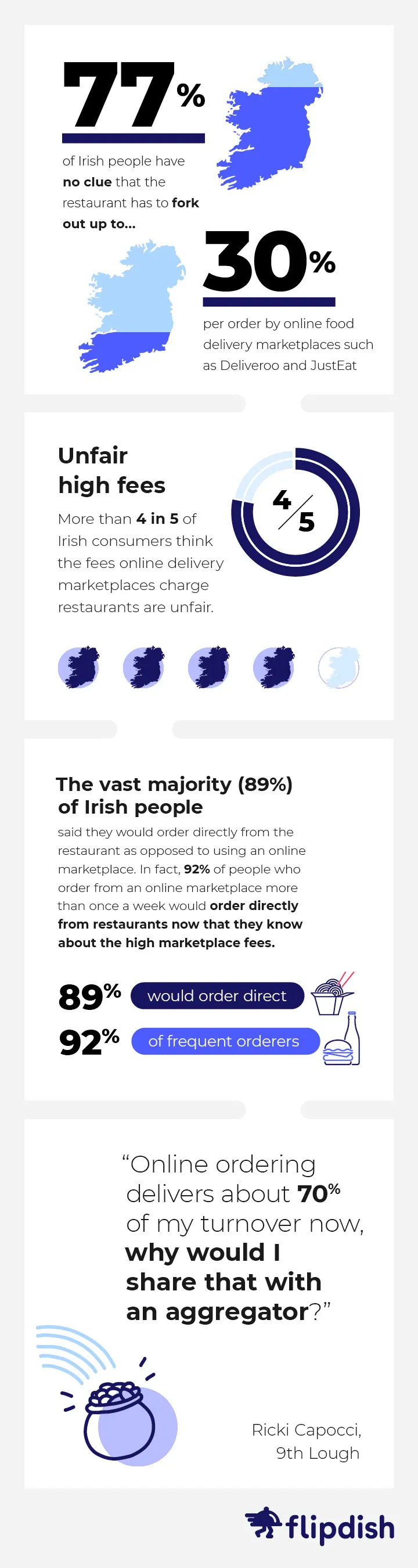
But that reach comes at a steep price. These marketplaces charge commissions of up to 30% on every order, and most customers have no idea how much of their payment never reaches the restaurant. Just as importantly, the marketplace owns the customer relationship and the data behind it, not you. This guide explains how third-party delivery works, what it actually costs, and how to reduce your reliance on it.
What are third-party delivery services?
Third-party delivery services, sometimes called aggregators or marketplaces, are platforms that list multiple restaurants in one place and handle ordering and, in most cases, delivery on their behalf. Customers browse the app, order from a restaurant, and the platform passes the order to the kitchen and arranges a driver.
The best-known examples in the UK and Ireland are Deliveroo, Uber Eats, and Just Eat. In exchange for access to their customer base and delivery network, they charge the restaurant a commission on each order.
How much do third-party delivery apps charge?
Commission rates vary by platform and by the level of service, but they typically run as high as 30% of the order value. On a £20 order, that can mean up to £6 going to the marketplace rather than the restaurant.
For a business operating on already-thin margins, that is a significant amount. A restaurant doing a high volume of marketplace orders can find that a large share of its delivery revenue is absorbed by commission before food, staff, and overhead costs are even accounted for. Most customers are completely unaware of this. They assume the money they pay goes to the restaurant they are ordering from.
The hidden cost: your customer relationship and data
The commission is the obvious cost, but it is not the only one. When a customer orders through a marketplace, that customer belongs to the marketplace, not to you. You do not get their contact details, their order history, or the ability to market to them directly.
That means every future order from that customer is one you have to keep paying commission on, because you have no way to bring them back on your own terms. Owning your customer data is what lets you build loyalty, run promotions, and encourage repeat orders without paying a fee each time. Without it, you are renting access to your own customers.
Why customers are happy to order direct
Here is the encouraging part. When customers understand how marketplace fees work, most are willing to order directly from the restaurant instead. People genuinely want to support their local restaurants and takeaways, and ordering direct is the most effective way to do that.
If you make your customers aware of the fees marketplaces charge, and make ordering direct easy through your own website or app, many will happily switch. It costs them nothing extra and they know more of their money is reaching the business they want to support.
How to reduce your reliance on third-party delivery
The goal for most restaurants is not necessarily to abandon marketplaces overnight, but to stop depending on them entirely. A balanced approach uses marketplaces for what they are good at, discovery, while steadily moving repeat customers to your own channels.
With your own online ordering website, a branded mobile app, and self-service kiosks in-store, you can take digital orders directly, at a far lower cost and with full control over the customer experience. Because you own the customer data, you can use restaurant marketing tools to bring customers back with offers and loyalty rewards, turning one-off marketplace discoveries into repeat direct customers.
Direct ordering also opens up more ways to grow revenue than a marketplace ever will. You can build new revenue streams and increase your average order value with upsells, bundles, and loyalty offers, none of which a commission-charging marketplace lets you do on your own terms.
Some restaurants go further and leave the marketplaces altogether once their direct channels are established. Flipdish customer Ricki Capocci, owner of the family-run Dublin takeaway 9th Lough, made exactly that shift: “I started working with the online marketplaces about ten years ago, but the longer I worked with them, the more expensive and difficult to deal with they became. I stopped working with them completely about three years ago and made the switch to having my own website and app that could take orders,” Capocci said.
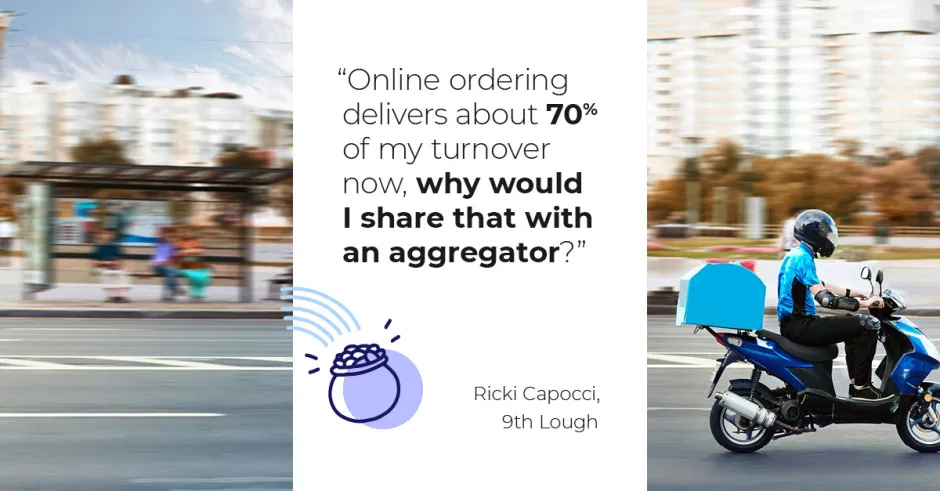
“Since then, my bottom line has increased, and so has my customer base and loyalty. Online ordering delivers about 70% of my turnover now, why would I share that with an aggregator?”
Get started with online ordering, powered by Flipdish, today
Frequently asked questions
Third-party delivery services are platforms such as Deliveroo, Uber Eats, and Just Eat that list multiple restaurants, take customer orders, and usually handle delivery. They give restaurants access to a large audience in exchange for a commission on each order.
Commission rates vary but can be as high as 30% of the order value. On a £20 order, that can mean up to £6 going to the platform rather than the restaurant. Rates depend on the platform and the level of service the restaurant signs up for.
Ordering directly from a restaurant means more of your payment reaches the business, since there is no marketplace commission. Many customers prefer to order direct once they understand how much of their money is taken in fees when they use a third-party app.
Not necessarily. Marketplaces are useful for helping new customers discover a restaurant. The most effective approach for most restaurants is to use marketplaces for discovery while encouraging repeat customers to order through their own website or app, where there is no commission and the restaurant keeps the customer relationship.
Restaurants can take direct digital orders through their own online ordering website, a branded mobile app, and in-store self-service kiosks. These channels let a restaurant accept orders at a much lower cost than marketplaces while keeping full control of the customer experience and data.

