

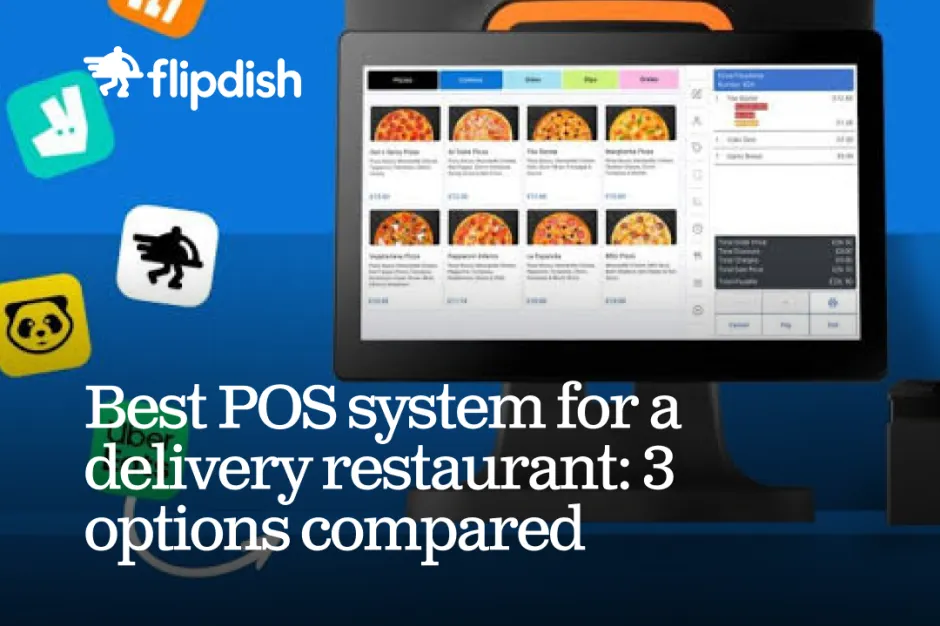
The best POS system for a delivery restaurant brings every order channel into one place, syncs your menu across platforms, and includes delivery-specific tools like driver tracking and a kitchen display system. Flipdish is the clear winner for delivery-focused restaurants because online ordering, apps, and delivery management are built in rather than bolted on. Square and Toast are capable systems, but both ask delivery operators to assemble more of the stack themselves.
For a delivery-focused restaurant, your POS is the backbone of the whole operation. It has to pull in orders from your website, your app, and third-party marketplaces, keep your menu consistent everywhere, and give your kitchen and drivers what they need to get food out fast and accurately.
Not every POS is built for this. Many are designed around dine-in service first, with delivery added as an afterthought. To help you choose, we have compared three of the leading options on the features that matter most for delivery, starting with the one built specifically for order-led restaurants.
What to look for in a delivery restaurant POS
Before the comparison, these are the features that matter most for a delivery operation:
All orders in one place. In-store, website, app, and marketplace orders should flow into a single system, with no manual re-entry.
Central menu management. One menu change should push out to every channel at once, rather than logging into five accounts.
Kitchen display system. A KDS organises and prioritises incoming orders and can drive customer and driver display screens.
Driver tracking. Real-time tracking keeps customers informed and helps you manage your delivery fleet.
Reporting and loyalty. Clear reporting across channels, plus loyalty that works online and offline, keeps delivery customers coming back.
Hold every POS up against that list. The gap between systems built for delivery and systems adapted for it shows up fast.
The 3 best POS systems for a delivery restaurant
1. Flipdish: the best POS for delivery restaurants
Our verdict: Flipdish wins on every delivery feature in the checklist above.
Flipdish is built for order-led restaurants, which makes it the natural choice for a delivery operation. Rather than treating delivery as an add-on, it brings online ordering, branded apps, marketplace management, and delivery into one connected POS system. Delivery is the starting point, not a feature you bolt on later.
Orders from your website, app, self-service kiosks, and third-party marketplaces all land in one place, with central menu management pushing updates across every channel at once. A fully customisable kitchen display system organises orders and can power customer and driver display screens, and delivery tools handle driver tracking and fleet management. Built-in reporting and loyalty that spans online and offline orders round out a system designed around how delivery restaurants actually work.
The result is one system, one menu, and one view of every order, with no stitching together of separate tools and no re-keying of marketplace orders.
Best for: independent and multi-location restaurants and takeaways that want online ordering, apps, and delivery management built into the POS rather than stitched together through integrations.
2. Square: a good starting point for simple setups
Square is a widely used POS known for its ease of use and free entry-level plan. For a small restaurant taking a modest volume of delivery orders, it is a straightforward, affordable starting point, with clear hardware and transparent payment pricing.
The trade-off is depth. Square handles online ordering and integrates with third-party delivery platforms, but some delivery-specific capabilities depend on add-ons or external integrations rather than being native. Delivery-led restaurants tend to outgrow that setup as order volumes rise and the number of tools to manage grows with them.
Best for: smaller restaurants and cafes that want a low-cost, easy-to-learn POS and have relatively simple delivery needs.
3. Toast: suited to larger, hardware-heavy operations
Toast is a restaurant-specific POS with a strong feature set and robust hardware built for high-volume kitchens. It offers online ordering, delivery options, and detailed restaurant management tools, and is popular with larger or multi-site operations in the markets where it operates.
Toast runs on its own Android-based hardware, which gives a consistent experience but means less device flexibility than a device-agnostic system like Flipdish. Pricing can climb as you add modules, so it suits established operations that will use the full breadth of the platform, rather than delivery-focused restaurants that want everything connected from day one.
Best for: larger restaurants and groups that want a comprehensive, hardware-led platform and will make use of its full module range.
Which POS is right for your delivery restaurant?
The right choice comes down to how central delivery is to your business.
If delivery and online ordering are the core of what you do, Flipdish is the clear choice. The ordering, app, and delivery tools are already connected, so you spend your time serving customers rather than managing integrations. Square is a sensible entry point if you are a small operation wanting a simple, low-cost start with light delivery needs. Toast is worth considering if you run a larger, hardware-heavy business that will use a wide module range.
For most delivery restaurants, that makes Flipdish the best fit. Whichever you shortlist, get a demo or trial first and test it against your real delivery workflow before committing. To see Flipdish in action, contact our team.
Frequently asked questions
The best POS for a delivery restaurant is one that brings all order channels into a single system, syncs your menu everywhere, and includes delivery tools like driver tracking and a kitchen display system. Flipdish is purpose-built for delivery-focused restaurants, while Square suits simpler setups and Toast suits larger hardware-led operations.
At a minimum it needs online ordering integration, central menu management across all channels, a kitchen display system, driver tracking, and reporting. Loyalty that works across online and offline orders and food safety tools are valuable additions for delivery operations.
Yes. A good delivery POS integrates with third-party marketplaces so those orders flow into the same system as your direct orders, removing the need to manage separate tablets and re-enter orders manually. Flipdish consolidates marketplace and direct orders in one place.
Costs vary by provider and setup. Some, like Square, offer a free entry-level plan with payment processing fees, while others charge a monthly subscription plus hardware. For delivery restaurants, the value is in reducing missed and mis-keyed orders and saving staff time, which usually outweighs the subscription cost.
Not necessarily. The best systems handle both, bringing dine-in, collection, delivery, and marketplace orders into one place. What matters for a delivery-focused restaurant is that the POS treats delivery as a core function, with menu syncing, driver tracking, and online ordering built in rather than added on.

