
Delivery first, store later: the 18-month experiment behind Ikkan Sushi
Ikkan Sushi launched five years ago as a delivery-only brand across the major marketplaces, testing whether its concept of affordable premium sushi would work before committing to a physical store. It ran that way for around 18 months before opening its first brick-and-mortar site. Founder Vipin now believes the delivery-only phase was the right way to validate demand cheaply, but says he waited too long to open physical stores. This article covers why the delivery-first model suited a new sushi concept, what the approach let Ikkan learn before spending on premises, the trade-offs of staying delivery-only, and the signals that tell an operator it is time to move from a screen-only brand to a physical presence.

There is a particular kind of courage in opening a restaurant with no restaurant.
No dining room. No shopfront. No passing trade wandering in because the window looked nice. Just a kitchen, a menu, and a bet that people will order food from a brand they cannot see, touch or walk past. That is how Ikkan Sushi started, and five years on, with three central London sites and a franchise model in the works, it is hard to argue the bet did not pay off.
But the more interesting part of the story is not that it worked. It is how founder Vipin used the delivery-only phase as a deliberate, low-cost experiment, and the one thing he now says he got wrong.
Starting with a question, not a storefront
When Vipin and his investors were figuring out what to build after the pandemic, sushi was the first idea on the table. Vipin had spent close to two decades in Pan-Asian kitchens, and the love for the product was there. But love for a product is not the same as proof that a business will work.
So rather than sign a lease and hope, they treated the launch as a test.
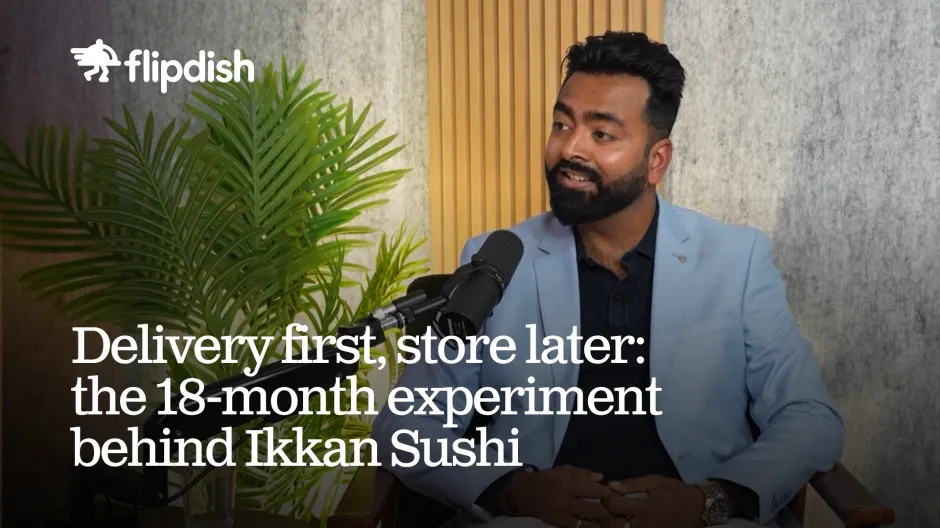
"When we started Ikkan Sushi, we started as a delivery only brand, and we started on all the major marketplaces," Vipin explained on the Flipdish Takeaways podcast. "We did not start as a store. When we started, it was more of an experiment. We wanted to know, will it do good? The concept that we have in mind, will it do good or not?"
That framing matters. A delivery-only launch is one of the cheapest ways to answer the single most important question any new food business faces: does anyone actually want this? You are not committing hundreds of thousands of pounds to a fit-out before you know. You are putting the food in front of real customers, at real prices, and watching what happens.
The concept they were testing was specific. Not the expensive, chef-with-a-knife end of the sushi market, and not the cheap high street version that so often disappoints. Ikkan was built to sit in the gap: affordable premium sushi, consistent enough to build a brand on. The delivery-only phase let them find out whether that gap was real and whether people would pay to fill it, without betting the business on the answer.
Why delivery-first suits a new concept
The delivery-only model, sometimes run from what the industry calls a dark kitchen or ghost kitchen, has become a well-trodden route for exactly this reason. It strips a food business back to its essentials and removes most of the cost and risk of a physical site.
Think about what you are not paying for in those early months. No prime retail rent. No dining room to design, furnish and staff. No front of house team. The overheads that sink so many new restaurants before they find their feet simply are not there. What you are left paying for is the thing that actually matters at the testing stage: the food, the kitchen and the delivery.
For a product like sushi, where freshness and quality are immediately obvious to the customer, that focus is an advantage. It let Ikkan pour its attention into sourcing and consistency rather than splitting it across a full restaurant operation on day one. As Vipin puts it, the most important part of quality is sourcing the right ingredients, and using them head to tail to maximise yield on thin margins. A delivery-only setup let that discipline take centre stage.
The model also gives you data. Every order through a marketplace or your own online ordering system tells you something: what sells, what does not, which areas order most, what people are willing to spend. By the time you are considering a physical site, you are not guessing about demand. You have months of evidence about where your customers are and what they want.
The one thing Vipin would do differently
Here is where the story turns, because Vipin is refreshingly honest about the mistake.
Ikkan ran delivery-only for roughly 18 months before opening its first physical store. Looking back, he thinks that was too long.
"We almost waited for almost one and a half years before starting our brick and mortar stores," he said. "I think we should have done that earlier."
It is a telling admission, and a useful one for any operator watching from the sidelines. The delivery-only phase is brilliant for validating a concept cheaply. But it is a starting point, not a destination. There comes a moment when the experiment has done its job, when you have your answer, and staying screen-only past that point means leaving growth on the table.
A physical store does things a delivery brand cannot. It creates visibility and trust. It captures passing trade. It gives customers a place to associate with the brand beyond an app icon. For Ikkan, whose whole positioning rests on being premium yet accessible, a well-placed store in an area like Marylebone or Covent Garden does real brand work that no amount of marketplace presence can replicate. Waiting 18 months to start that work was, in hindsight, 18 months of brand-building deferred.
The lesson is not that delivery-first is wrong. Vipin would clearly do it again. The lesson is about timing: run the experiment, read the results, and then move decisively once the data tells you the concept works.
Knowing when to make the jump
So how do you know when the delivery-only phase has run its course? Vipin's experience points to a few signals worth watching.
The clearest one is consistent, repeat demand. If the same postcodes are ordering again and again, and your order volumes are stable or climbing rather than spiking and fading, the market has told you the concept works. That is your green light.
The second is when you can see a location that makes sense. Ikkan's revenue splits roughly evenly between dine-in, takeaway and delivery, with deliveries alone accounting for around half. When you are scouting a physical site off the back of a delivery brand, you already know your delivery radius, your busiest areas and your customer base. That takes a lot of the guesswork out of choosing where to open, because the data from your delivery-only phase is effectively a heatmap of where your customers already are.
The third signal is operational readiness. A physical store is a different beast to a delivery kitchen, with front of house, dine-in service and longer hours. Ikkan's answer to this was to build small, replicable sites designed to run lean, some managed with as few as one or two people, underpinned by strict standard operating procedures. Having that operational discipline in place before expanding is what allows the jump from delivery brand to physical store to happen without the wheels coming off.
The bigger picture
What makes the Ikkan story useful is that it captures both sides of the delivery-first model honestly.
On one hand, launching delivery-only was exactly the right way to test an unproven concept without betting the business on it. It kept costs low, kept the focus on food quality, and generated the evidence that made everything since possible. On the other, treating it as a comfortable long-term position rather than a launchpad cost Ikkan time it cannot get back.
For any operator sitting on a food idea they believe in, that is the balance to strike. Use delivery-first to answer the question cheaply. Then, once the answer is yes, do not wait too long to build on it. The tools to run either model, or both at once, are more accessible than they have ever been, whether that is marketplace integration, your own branded ordering, or a dark kitchen ordering system built for delivery-only operations.
The experiment worked. The only regret is not acting on the result sooner.
Listen to the full episode
This conversation is from Season 3 of the Flipdish Takeaways podcast. Vipin covers everything from the meaning behind the Ikkan name, to the viral sushi doughnut, to why he thinks you have to be a little bit crazy to run a restaurant at all.


