

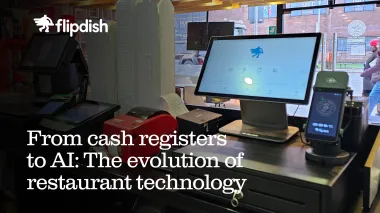
The restaurant industry has undergone a remarkable technological transformation over the past century. From the introduction of the first mechanical cash register to today's cloud-based systems powered by artificial intelligence, technology has fundamentally changed how restaurants operate, serve customers, and manage their businesses.
This evolution hasn't just been about keeping up with the times. It's been about survival, efficiency, and meeting ever-changing customer expectations in an increasingly competitive marketplace.
Table of contents
- The pre-digital era: Manual systems and paper trails
- The 1970s-1980s: The dawn of electronic POS systems
- The 1990s: Computerisation and early integration
- The 2000s: The internet changes everything
- The 2010s: Mobile revolution and cloud computing
- The 2020s: AI, automation, and unified ecosystems
- What's next: The future of restaurant technology
The pre-digital era: Manual systems and paper trails
Before electronic systems existed, restaurants operated entirely on manual processes. Staff wrote orders on paper tickets, which were physically carried to the kitchen. Cash registers were purely mechanical devices that recorded transactions but provided minimal reporting capabilities.
Challenges of the manual era:
- High error rates from illegible handwriting
- Lost or misplaced paper tickets
- Difficulty tracking inventory
- No real-time sales reporting
- Time-consuming end-of-day reconciliation
- Limited ability to analyse business performance
Restaurant owners relied on intuition and experience rather than data. Financial reporting meant manually counting cash, reconciling receipts, and spending hours with ledgers and calculators.
The 1970s-1980s: The dawn of electronic POS systems
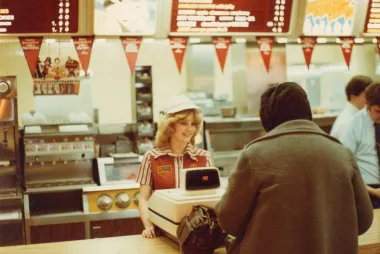
The 1970s marked the arrival of the first electronic cash registers (ECRs), like IBM's 3650 launched in 1973 for restaurants such as McDonald's. These replaced mechanical tills with basic computing for sales tracking and simple reporting. By the late 1970s and into the 1980s, microprocessor-powered POS systems emerged, enabling electronic menu storage, order processing, and kitchen integration, though touchscreens wouldn't appear until 1986 with Gene Mosher's ViewTouch system.
Key innovations:
- Electronic order entry replacing handwritten tickets
- Basic sales reporting and daily summaries
- Reduced calculation errors at checkout
- Faster order processing
- Introduction of kitchen printers
Companies like NCR and IBM introduced restaurant-specific terminals that could handle orders, payments, and basic inventory tracking. However, these systems were expensive, bulky, and required significant technical expertise to operate and maintain.
The 1980s saw wider adoption as costs decreased and reliability improved. McDonald's pioneered the use of POS systems across their franchises, setting a standard that would influence the entire industry.
The 1990s: Computerisation and early integration
The 1990s brought personal computers into restaurant operations, enabling more sophisticated software and database management. Restaurant POS systems evolved from standalone terminals to networked systems that could share data across multiple stations.
Major developments:
- Windows-based POS software
- Basic inventory management systems
- Employee time tracking and scheduling
- Credit card processing integration
- Networked systems connecting front and back of house
- Early reservation systems
This era also saw the emergence of specialised software for different restaurant types. Quick service restaurants needed different features than fine dining establishments, leading to more tailored solutions.
The introduction of barcode scanning and early loyalty programmes gave restaurants new ways to track inventory and customer behaviour, though these systems remained largely disconnected from each other.
The 2000s: The internet changes everything
The arrival of broadband internet transformed restaurant technology from isolated systems to connected platforms. This decade introduced online ordering, digital marketing, and the first smartphone applications.
Revolutionary changes:
- Online ordering through restaurant websites
- Third-party delivery platforms emerge (Just Eat, Deliveroo)
- Email marketing and customer databases
- Early social media marketing
- Online reservation systems
- Cloud-based storage begins
Restaurants suddenly had to manage multiple channels: dine-in, phone orders, and online orders. This created new operational challenges as food delivery services became mainstream.
The iPhone's launch in 2007 set the stage for mobile technology to dominate the next decade. Restaurants began to understand that customers expected digital convenience, not just quality food.
The 2010s: Mobile revolution and cloud computing
The 2010s witnessed explosive growth in mobile technology and cloud computing, fundamentally changing customer expectations and restaurant operations. Smartphones became ubiquitous, and customers expected to order food with a few taps.
Transformative technologies:
- Cloud-based POS systems accessible from anywhere
- Mobile ordering apps
- Contactless payments (Apple Pay, Google Pay)
- Kitchen Display Systems replacing paper tickets
- Social media marketing becomes essential
- Data analytics and business intelligence
- Self-service kiosks in quick-service restaurants
Restaurant iPad POS systems became popular due to their affordability and ease of use compared to traditional terminals. Cloud computing meant restaurants could access sales data, update menus, and monitor operations from anywhere with an internet connection.
The rise of delivery aggregators created a new challenge: managing orders from multiple platforms simultaneously. Restaurants needed integration solutions to prevent chaos during busy periods.
This decade also saw the beginning of data-driven decision making. Restaurants could finally analyse which menu items performed best, identify peak hours, understand customer preferences, and adjust operations accordingly.
The 2020s: AI, automation, and unified ecosystems
The COVID-19 pandemic accelerated technological adoption across the hospitality industry. Contactless ordering, QR code menus, and automated systems shifted from "nice to have" to essential survival tools almost overnight.
Current innovations:
- AI-powered voice ordering and chatbots
- Unified ecosystems connecting all ordering channels
- Advanced Kitchen Display Systems with prep time tracking
- Contactless QR code ordering and payment
- Sophisticated inventory management with predictive ordering
- Real-time labour cost management
- Integrated marketing automation
- Self-service technologies across all restaurant types
Modern restaurant EPOS systems now function as complete business management platforms. They handle everything from order management and payment processing to staff scheduling, inventory control, and customer relationship management.
The focus has shifted to unified platforms that eliminate the fragmentation of previous decades. Rather than cobbling together separate systems for different functions, restaurants now seek all-in-one solutions that integrate seamlessly.
Self-service kiosks have evolved from experimental technology to standard equipment in many quick-service and fast-casual concepts. Studies show they increase average order values whilst reducing labour costs and queues.
Artificial intelligence now powers everything from demand forecasting to personalised menu recommendations. AI phone agents can handle customer calls, take orders, and answer questions without human intervention.
The rise of ghost kitchens and virtual restaurants demonstrates how technology has enabled entirely new business models that would have been impossible just a decade ago.
What's next: The future of restaurant technology
Looking ahead, several emerging technologies promise to further transform the restaurant industry:
Artificial intelligence and machine learning
AI will become more sophisticated, offering predictive analytics that help restaurants anticipate demand, optimise staffing, and reduce waste. Personalisation will reach new levels, with systems remembering individual customer preferences and dietary requirements across visits.
Robotics and automation
Robotic cooking systems and automated food preparation are moving from experimental to practical. While unlikely to replace human chefs entirely, these technologies will handle repetitive tasks, improve consistency, and address labour shortages.
Voice technology
Voice ordering will become more natural and widespread, both for customer orders and kitchen communication. Voice-activated systems will allow staff to manage orders, update systems, and access information hands-free.

Augmented reality
AR could transform how customers interact with menus, allowing them to see 3D representations of dishes before ordering. Training staff could become more effective through AR-guided tutorials.
Blockchain for supply chain
Blockchain technology may provide unprecedented transparency in food sourcing and supply chain management, crucial for food safety and sustainability verification.
Internet of things (IoT)
Connected devices will monitor everything from food temperatures to equipment maintenance needs, alerting staff before problems occur rather than after. The future of restaurant technology isn't about replacing human hospitality but enhancing it. The best systems will free staff from tedious tasks, allowing them to focus on creating memorable guest experiences.
The evolution of restaurant technology reflects broader changes in society, customer expectations, and business practices. From mechanical cash registers to AI-powered systems, each innovation has aimed to solve real operational challenges whilst improving the customer experience.
For restaurant owners and operators, understanding this evolution isn't just about nostalgia. It's about recognising patterns, anticipating future changes, and making informed decisions about technology investments that will determine success in an increasingly competitive and digital marketplace.
The restaurants that thrive will be those that embrace technology not as a replacement for hospitality but as a tool to deliver it more effectively, efficiently, and consistently than ever before.
FAQs
Restaurants began using mechanical cash registers in the late 1800s, but electronic POS systems didn't arrive until the 1970s. The real digital transformation began in the 1990s with computerised systems and accelerated dramatically in the 2000s with the internet and mobile technology. Today, technology touches every aspect of restaurant operations from ordering to inventory management.
Modern restaurant technology has dramatically improved efficiency by eliminating manual processes, reducing errors, and providing real-time data. Cloud-based POS systems consolidate orders from multiple channels, Kitchen Display Systems eliminate lost paper tickets, and automated inventory management prevents stockouts. These improvements allow restaurants to serve more customers with fewer staff whilst maintaining quality and reducing waste.
The most important technology is a unified system that integrates all aspects of restaurant operations. Rather than separate systems for POS, online ordering, inventory, and marketing, modern restaurants benefit most from comprehensive platforms that connect everything. This integration provides better data, reduces errors, simplifies staff training, and allows restaurants to adapt quickly to changing customer expectations and market conditions.