
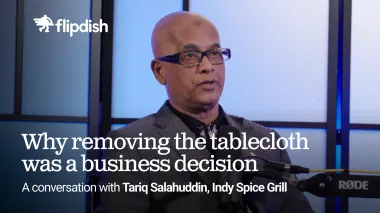
Why removing the tablecloth was a business decision
A conversation with Tariq Salahuddin, Indy Spice Grill
A 40-year restaurateur explains the small operational choices that most owners overlook. They are the ones that quietly compound into better margins, better reviews, and customers who come back for generations.
Tariq Salahuddin has run restaurants and takeaways in Ireland and Northern Ireland since 1984. In a recent conversation on the Flipdish Takeaways podcast, he described a philosophy of marginal gains that most operators never articulate but quietly live by. The biggest insight: removing the tablecloth was not an aesthetic choice. It was a strategic one. This piece unpacks what that decision represents and why small operational details like it are among the most powerful levers available to independent restaurant owners.

There is a version of restaurant operations thinking that chases the big wins. New menus. Bigger premises. More marketing spend. And there is another version, quieter and considerably harder to copy, that obsesses over the details nobody else is paying attention to.
Tariq Salahuddin has been practising the second version for over four decades. As owner and director of Indy Spice Grill, with locations in Dublin and Belfast, he has watched food trends, delivery models, and dining culture shift almost beyond recognition. What has not shifted is his conviction that the most important business decisions are often the smallest ones.
The tablecloth is a perfect example.
The problem with tablecloths nobody was talking about
When Tariq opened his first proper restaurant in Belfast in 1992, tablecloths were standard. Every Indian restaurant had them. Most casual dining rooms had them. They were a signal of formality and effort, a way of saying: this is a real restaurant, not just somewhere to eat.
But Tariq started noticing something. "Sometimes tablecloths were kind of dirty," he recalled, "but people didn't change them." Corners were stained. Creases had turned grey. The tablecloth that was supposed to communicate quality was doing the opposite. Customers were sitting down and, before they had even looked at a menu, they had already registered something was off.
"The more things you put on the table, the more chances there are of them not being looked after or maintained properly."
Tariq Salahuddin, Indy Spice Grill
His solution was to remove them entirely. Clean, well-maintained table surfaces. A table mat. Nothing that could quietly deteriorate between services and undermine the experience before a word had been spoken.
It sounds simple. It is simple. But think about what that decision actually involved: accepting that a visible symbol of effort was causing more damage than the effort it represented. That takes a certain kind of operational honesty that is genuinely rare.
Minimalism as a margin strategy
The tablecloth decision was not just about cleanliness. It was also a cost decision, even if Tariq frames it primarily through the lens of customer experience. Fewer linens mean lower laundry costs. Fewer items on tables mean fewer things to restock, replace, or account for. The operational surface area of the business shrinks, and with it the number of ways things can go wrong.

This is a principle that scales well beyond the tablecloth. Every unnecessary complexity in a restaurant operation is a liability: a potential failure point, a training burden, a cost line. The operators who last decades in this industry tend to be ruthless about this, not because they are cutting corners but because they understand that simplicity and quality are not in tension. They reinforce each other.
Indy Spice Grill is described, in a phrase Tariq clearly cherishes, as offering "five-star quality at a three-star price." That positioning did not happen by accident. It is the direct result of channelling resources towards the things customers actually notice and quietly eliminating the things they do not.
What customers actually notice
One of the more interesting things about this approach is what it reveals about customer perception. Customers rarely notice when operations are running smoothly. What they notice is when something is wrong: a sticky menu, a table that has not been properly wiped, a wait that goes unacknowledged. The absence of problems is invisible. The presence of one small problem is memorable.
This asymmetry has real implications for how restaurants should allocate their attention. The marginal return on adding another flourish to an already-good experience is low. The marginal return on eliminating a recurring irritant is enormous, because that irritant is actively eroding the goodwill the rest of your operation has built.
Tariq's instinct to keep tables "minimalistic" is a direct expression of this. Rather than adding more to signal quality, he removed things that were quietly signalling the opposite. The result is a cleaner environment that is also easier and cheaper to maintain, and one that puts the focus precisely where it belongs: on the food and the service.
The compound effect of small decisions
What makes Tariq's story genuinely instructive is the timeframe over which these small decisions compound. He has customers who first visited in 1984. He has a family who recently came in four generations strong. He has chefs who have worked for him for 30 years. These are not accidents of luck or location. They are the accumulated result of thousands of small decisions, made consistently, over decades.
The tablecloth is one of those decisions. So is the policy of never arguing with a customer who says they received the wrong dish, and instead finding out what they actually wanted. So is the choice to go direct with online ordering rather than remain dependent on expensive third-party commissions that were "eating away profit." Each decision, individually, is unremarkable. Together, they build something that is very difficult for a competitor to replicate, because it cannot be copied overnight. It has to be earned over time.
This is also why Tariq's approach to technology adoption looks the way it does. He was not an early adopter for the sake of novelty. He adopted EPOS systems in 1992 because they eliminated order errors. He moved to online ordering when the economics made sense and when the platform, Flipdish among them, made it genuinely accessible for independents. His online ordering now accounts for roughly 90% of takeaway volume. That transition happened because each technological step solved a real problem rather than creating new ones.
The question worth asking in your own operation
The tablecloth question is really a proxy for a broader audit that every restaurant owner should run periodically. It goes something like this: what are the things in my operation that are supposed to signal quality but are, in practice, doing the opposite? What are the things I am maintaining out of habit rather than because they are actually serving customers well?
Those things might be physical, like tablecloths. They might be procedural, like a complicated ordering flow on your website that is driving abandonment before customers reach checkout. They might be structural, like a menu that has grown so large it is impossible to execute consistently at volume. The category does not matter. The discipline of asking the question does.
Tariq has been asking it for 40 years. His restaurants show what the answer looks like when you take it seriously.
Listen to the Full Podcast

FAQs
Marginal gains refers to the practice of making many small improvements across an operation rather than relying on a single large change. In a restaurant context, this might include simplifying table settings, tightening order accuracy, reducing menu complexity, or switching to a lower-cost online ordering platform. Each change may seem minor in isolation, but the cumulative effect on customer experience, staff efficiency, and profit margins can be significant over time.
Fewer items on tables reduces laundry and linen costs, lowers the risk of visible deterioration between services, and decreases the number of things staff need to maintain, replace, or check during turnaround. It also reduces the chance of a small detail negatively affecting a customer's first impression. For independent operators working with thin margins, this kind of operational simplification often delivers a better return than adding new features or products.
Independent restaurants typically cannot compete with chains on marketing spend or brand recognition. What they can do is offer consistency, genuine community connection, and attention to detail that larger operations struggle to maintain at scale. Operators like Tariq Salahuddin demonstrate that long-term loyalty is built through repeated small acts of care: getting orders right, handling complaints graciously, keeping the environment clean and simple, and making customers feel genuinely welcomed rather than processed. These things are difficult to systemise at chain scale, which is precisely where independents have an advantage.