
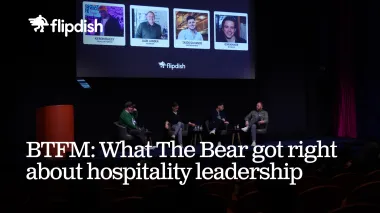
BTFM: What The Bear got right about hospitality leadership
At Dished Live '25, Brother Marcus co-founder Tasos Gaitanos revealed how a single scene from The Bear Season 2, Episode 7 became the cultural shorthand his team now uses to deliver extraordinary guest experiences. Known internally as BTFM, the framework is built around empowering every team member to find the right moment, read the guest, and do something unexpected and memorable. This article unpacks what BTFM actually means in practice, why it works at scale, and what hospitality operators of any size can take from it.

If you have ever found yourself watching The Bear and thinking "this is uncomfortably close to real life," you are not alone. The show has become something of a cultural touchstone for the hospitality industry, capturing the pressure, the passion and the dysfunction that anyone who has worked a busy service will recognise instantly.
But there is one moment in particular from Season 2, Episode 7 that has crossed the line from television drama into actual operational practice. At Dished Live '25, our flagship annual event, Brother Marcus co-founder Tasos Gaitanos described how that scene became the foundation of a values framework now embedded across the brand's eight London sites.
He calls it BTFM.
What happens in that scene
In Episode 7 of Season 2, Richie, arguably the most infuriating character in the show, is sent on a stage placement at a fine dining restaurant. It is the episode where everything clicks for him. After watching how the front of house team operates at the highest level, he returns to The Bear, gathers his team and delivers a rallying call: they are going to go out and blow their f*** minds.
It is a moment of transformation. Richie stops being reactive and starts being intentional. He stops managing and starts leading. He stops processing guests and starts actually seeing them.
For Tasos, watching that scene was a recognition moment.
"We now have it as a symbol that runs through our business," he explained to the audience at Dished Live '25. "BTFM. It's a bit more sensible. We've put little stickers in the corners of the restaurants. Everyone has the budget, has the empowerment to go out and do that."
Why it resonates so specifically in hospitality
The reason that scene lands so hard is not the acronym. It is the philosophy underneath it.
Most hospitality training focuses on the what. Here is how you take an order. Here is how you clear a table. Here is the sequence of service. These are necessary, but they are not what makes someone leave a restaurant wanting to tell every person they know about it.
What Tasos and co-founder Alex built BTFM around is the how and the when. As he put it at Dished Live '25: "You have to see and listen to that guest, pick up that breadcrumb, and then find a way to go and deliver it."
That breadcrumb concept is important. It means no BTFM moment is scripted. It cannot be. It requires presence, it requires attention and it requires the confidence to act on what you have noticed. That is a very different skill set to memorising a steps-of-service document.
What it looks like in practice
At Dished Live '25, Tasos shared two examples that make the framework feel tangible.
The first involved his own mother. She came into a Brother Marcus restaurant and mentioned she had loved a dish that had been taken off the menu just two days earlier. Rather than apologising and moving on, the team went into the kitchen and made it for her.
The second happened more recently. A guest had seen a collaboration Brother Marcus was running with a nearby pizza restaurant called Cross Brothers and came in hoping to try the pizza. The team no longer had it. Rather than turning the guest away, the manager went to the pizza place, collected the order and ran it back across Covent Garden so the guest could have it as a takeaway on their way home.
Neither of those moments appears in any training manual. Both of them almost certainly generated more word-of-mouth value than any marketing campaign could.
The point is not that teams should be running across Covent Garden every service. The point is that the culture exists where someone in that situation felt both the freedom and the motivation to do it.
The three things that make BTFM work
BTFM is not just a rallying cry. For it to function consistently at scale, particularly across eight sites doing around 8,000 covers a week, three structural things have to be in place.
1. Genuine empowerment, not theoretical empowerment
There is a version of empowerment that exists on laminated posters in staff rooms and nowhere else. Brother Marcus has worked hard to make sure that every team member understands they actually have a budget and actual authority to act. "Everyone has the budget, has the empowerment to go out and do that," Tasos said at Dished Live '25. Without that being real and understood, team members will always default to asking a manager, and the moment passes.
2. Timing over instinct
This is the subtle part that often gets missed. Tasos made clear that BTFM is not about random acts of generosity sprinkled through service. It is about timing. The difference between a gesture that feels magical and one that feels performative is almost entirely about when it happens. Reading a guest well enough to find the right moment is a teachable skill, but it takes practice and the psychological safety to get it wrong sometimes while you learn.
3. Values that give the framework a foundation
Brother Marcus operates with four core values: joy (expressed through the Greek word kefi, meaning the capacity to find happiness in the ordinary), curiosity, consistency and integrity. BTFM sits on top of those values rather than replacing them. A team that understands why joy matters will approach a BTFM moment very differently to a team that has simply been told to do something memorable. Context gives the framework meaning.
The bigger leadership lesson
What makes the BTFM story significant beyond Brother Marcus is what it reveals about how culture actually travels inside a growing business.
Tasos and Alex did not write a values document and pin it to a wall. They found a reference point, a piece of shared cultural language from a show their teams were already watching, and they made it mean something real by attaching it to actual behaviours, actual budgets and actual stories.
That is a fundamentally different approach to values communication. It is bottom-up rather than top-down. It is specific rather than aspirational. And critically, it gives team members something to identify with rather than something to comply with.
Kieron Bailey, who hosted the panel discussion at Dished Live '25, has long argued that the best hospitality is essentially free. The BTFM framework is a practical expression of that idea. Running across Covent Garden for a pizza costs very little. Printing a photo of a Barbados beach to give a guest in a basement restaurant their requested "table with a view" (another story that emerged during the same panel, from Blacklock founder Gordon Kerr) costs nothing at all. What these moments require is not budget. They require a team that cares enough to notice, and a culture that gives them permission to act.
What operators can take from this
You do not need a cult-favourite television series to build a BTFM equivalent in your business. But you do need a few things.
You need a clear understanding of what your version of extraordinary looks like, specific enough that a team member on their third shift can picture it. You need to make sure that empowerment is genuine, which means making it explicit, backing it when things go wrong and celebrating it loudly when things go right. And you need the kind of values underneath it that give people a filter for their decisions rather than a script.
The acronym is almost beside the point. What matters is the question it asks of every person on your floor every single service: have I actually seen this guest today? And if I have, what am I going to do about it?
Hear more from the people building it
The BTFM conversation was just one part of a wide-ranging panel at Dished Live '25 that covered intent-based leadership, recruiting for genuine care, sustainable growth and why most hospitality values are wallpaper. The full session featured Tasos Gaitanos alongside Gordon Kerr, founder and CEO of Blacklock, and Jack Lander, founder of Pizza Rover, with Kieron Bailey hosting.
If you want to be in the room for conversations like this, Dished Live '26 is coming. Get your tickets now.