
75% online, 25% walk-in: inside the order mix at one of Dublin's busiest sushi spots
Michie Sushi in Sandyford, Dublin, now generates roughly 75% of its orders online and 25% from walk-ins, a near total reversal of how the business ran when it opened. Owner Michel Piare started out delivering leaflets door to door and taking every order over the phone himself. Today, the majority of demand arrives through apps and ordering platforms before a single customer sets foot in the restaurant. This article looks at what drove that shift, what it changes operationally, why the remaining walk-in trade still matters, and what the split reveals about where independent restaurant ordering is heading.

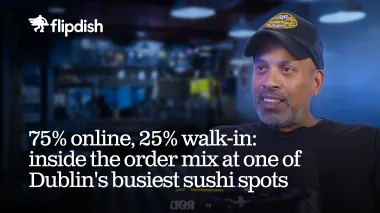
Ask Michel Piare how his customers order from Michie Sushi these days, and the answer comes without much hesitation: about 75% online, 25% walking through the door.
That number is worth sitting with for a second, because it is not how the business started. When Michel opened Michie Sushi in Dublin, there was no app to open, no website to browse. There was him, a phone number printed on a leaflet, and hours spent walking door to door hoping somebody would call.
"In the beginning, it was very tough," he said on the Flipdish Takeaways podcast. Nobody knew the brand yet, so Michel spent hours walking door to door, pushing leaflets through letterboxes with his own phone number printed on them and hoping somebody would call.
Fast forward to today, and Michie Sushi sits in the Beacon South Quarter in Sandyford, surrounded by office blocks, doing three quarters of its trade before anyone walks in. That reversal says a lot about where independent restaurant ordering has actually gone, not in theory, but in the daily reality of one busy kitchen.
How a restaurant ends up at 75% online
Michel is candid about why the split looks the way it does. It is not really a strategy so much as a reflection of how people now behave.
"I think it was more of a personal touch whereas now it's everybody's on their smartphones and nobody wants to cook anymore," he said. Fewer people are picking up the phone at all, and when they do want food, the instinct is to reach for an app rather than dial a number.
Michie Sushi runs on multiple channels simultaneously to capture that demand. Michel describes the approach as casting a wide net: Flipdish alongside every other platform available, with orders flowing in from several directions at once and landing on a bank of order terminals in the kitchen. "You can't just go with one company," he said. "You go with every single company and it just trawls in every single order."
That is a deliberate acknowledgement that customers now discover and order from restaurants across a scattered set of touchpoints, and a business that only accepts orders through one channel is quietly turning away demand it never sees.
What a 75/25 split actually changes in the kitchen
A number like this is not just interesting on paper. It changes the shape of a working day.
Michel's own schedule starts at five in the morning and runs until nine at night, with lunch service in Sandyford landing in a tight two-hour window when the surrounding offices empty out at once. When that much of the business arrives digitally, the kitchen has to be built around order terminals and prep timing rather than a front of house team managing a queue.
It also changes what "busy" looks like from the outside. A restaurant doing three quarters of its business online can look quiet through the window while the kitchen is at full tilt processing a wall of digital tickets. That is a genuinely different operational rhythm to a business built primarily around footfall, and it rewards a kitchen layout and prep routine designed around volume and speed rather than table turns.
For an operator with this order mix, the reliability of the ordering technology stops being a nice-to-have and becomes close to existential. If the credit card machine goes down, Michel is blunt that it would put the business in serious trouble. The same logic extends to the ordering platforms themselves. When three quarters of your revenue depends on digital channels working correctly every single service, resilience is not a minor operational detail, it is the backbone of the business.
The 25% that still matters enormously
It would be easy to read a 75/25 split as evidence that walk-in trade is fading into irrelevance. Michel's experience suggests the opposite.
Being based in an office-heavy part of Dublin means that quarter of business arrives in concentrated bursts, largely during that same lunch window, and it carries its own value beyond the immediate sale. Walk-in customers are the ones who taste the food for the first time without an app screen between them and the decision, and word of mouth still does real work. Michel credits exactly that dynamic with the business's early growth, well before any delivery platform existed: people tried it, told their friends, and the business grew from there.
The walk-in customer today plays a similar role, just at a smaller scale relative to the whole. They are often the ones popping in on a whim because the location works, and converting a good first experience into a repeat online order is where a branded ordering app or website becomes genuinely useful. A customer who walks in once and has a great meal is a strong candidate to become one of the 75% the next time, provided the restaurant makes it easy for them to find and reorder.
Owning the relationship behind the numbers
The other side of a heavily online order mix is what it does for customer data, and this is where Michel's approach becomes more deliberate.
Running across multiple marketplaces at once means accepting the commissions that come with them, something Michel is realistic about. "There's fees, you know, to be online, but at the end of the day, you have to get in every single market," he said. But he is equally clear that Flipdish is the platform of choice, precisely because ordering through a direct, branded channel means the restaurant keeps the relationship with the customer rather than handing it entirely to a third party.
That distinction matters more as the online share of the business grows. A restaurant doing three quarters of its trade digitally, but with all of that data locked inside marketplace apps, has very little ability to reach those customers again on its own terms. A restaurant that can see order history and contact its regulars directly can re-engage them, run loyalty offers and understand its own patterns rather than guessing. At Michie Sushi's volume, that difference compounds fast.
What this order mix says about where things are heading
Michel has been in hospitality for over three decades, long enough to watch this shift happen from the inside rather than read about it. His read on the change is straightforward: technology, and specifically the arrival of online ordering and delivery platforms, opened the door to a wave of new competition that simply did not exist when he started.
He does not frame that as a threat. If anything, he sees competition as healthy, pushing standards up across the board. But the practical consequence for any independent restaurant today is that customer expectations have moved permanently. Fewer people want to make a phone call. Almost everyone has a smartphone in their pocket at the exact moment hunger strikes, and the restaurants that make that moment frictionless are the ones capturing the growing share of demand that no longer arrives through the door at all.
A 75/25 split is not necessarily where every restaurant should land. A destination restaurant with strong footfall in a high street location will have a different balance to an office-adjacent takeaway. But the direction of travel Michel describes, more of the business arriving digitally before a customer is ever physically present, is consistent with what is happening across independent hospitality more broadly. The operators paying attention to that ratio, and building their ordering technology and data strategy around it, are the ones putting themselves in the strongest position for whatever the next split ends up looking like.
Listen to the full episode
This conversation is from the Flipdish Takeaways podcast. Michel Piare talks through 35 years in hospitality, from washing rice for two years at Benihana in London to building Michie Sushi into Ireland's number one sushi brand, along with his plans to open ten more stores.


