
Restaurant inventory management: how to reduce waste and protect margins
Restaurant inventory management is the practice of tracking, ordering, and controlling stock so that food cost stays predictable and waste stays low. Most restaurants lose margin quietly through over-portioning, poor stock rotation, and ordering that's based on habit rather than actual sales data. The fix isn't complicated. It's a weekly stock count compared against sales, clear par levels for ordering, first-in-first-out rotation, and portion specs that are actually followed at the pass. Restaurants that do this consistently typically see food cost percentage drop by several points within a few months, without changing a single recipe.

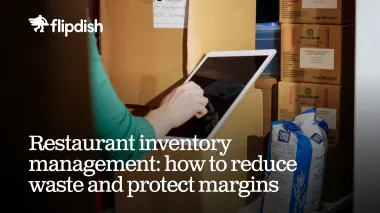
There's a version of your menu that customers never see and never pay for. It's the food that gets over-portioned because nobody's watching. The delivery that arrived a day early and sat too long before anyone used it. The prep that got made in a big batch because it was quicker, and then half of it got binned at the end of service because demand didn't match the guess. Call it the invisible menu. It has real ingredients, real labour, and a real cost, and it generates precisely nothing in return.
Every restaurant has one. The only question is how big it's allowed to get before someone notices.
Inventory management sounds like the least exciting part of running a restaurant, and that's probably why so many operators treat it as an afterthought. It's not the part of the job anyone got into hospitality for. Nobody dreams of counting tins of chopped tomatoes on a Sunday morning. But the restaurants with the healthiest margins tend to be the ones where someone actually does that counting, consistently, and pays attention to what it tells them.
Why inventory quietly becomes a margin problem
Food cost doesn't usually blow out because of one big mistake. It creeps. A slightly generous portion here. A supplier delivery that got double-ordered because nobody checked what was already in the walk-in. A dish that got 86'd too late because stock ran out mid-service and nobody had flagged it.
None of that shows up dramatically on a P&L. What shows up is a food cost percentage that's a couple of points higher than it should be, month after month, and an owner who can't quite explain where the difference is going. That's usually the inventory problem hiding in plain sight.
The industry standard for food cost sits somewhere between 28% and 35% of revenue, depending on your concept. A couple of points might not sound like much. On a restaurant doing half a million pounds a year in food sales, two percentage points of food cost is ten thousand pounds. That's not a rounding error. That's a member of staff's salary, or a kitchen refit, or simply profit that should have stayed in the business.
Start with the count, not the software
There's a temptation to solve inventory problems by buying a system. Software genuinely helps, and we'll get to that, but it solves nothing on its own if nobody's doing the basic discipline underneath it. A stock management platform that nobody updates accurately is just an expensive way of tracking a guess.
The starting point is a proper weekly stock count. Not a glance around the walk-in to see if things look roughly right. An actual count of key items, written down, compared against two numbers: what was ordered in that period, and what should have been used based on sales.
The gap between what should have been used and what's actually gone is your variance. That variance is where the answers live. If chicken is disappearing faster than your sales data says it should, you've either got a portioning problem, a waste problem, or, less pleasantly, a theft problem. If you never run the count, you never see the gap. You just see a food cost number that's higher than you'd like and no way to explain why.
Weekly is the right cadence for most restaurants. Daily counts on your highest-value, highest-shrinkage items (meat, seafood, alcohol) can be worth the extra effort if those categories are a big share of your cost base. Monthly is too slow. By the time a monthly count flags a problem, you've already absorbed a month of it.
The habits that actually reduce waste
Once the counting is in place, the day-to-day habits are what keep the numbers honest.
First in, first out. It sounds obvious and it's routinely ignored under pressure. New stock gets pushed to the back of the shelf because it's easier, and older stock quietly passes its best point while sitting behind it. Labelling and dating everything the moment it comes in, and training staff to always pull from the front, closes this gap without costing anything.
Par levels instead of gut-feel ordering. A par level is simply the minimum amount of an item you want on hand before you reorder. Setting these properly, based on your actual weekly usage rather than what feels right, stops the two most expensive ordering habits: panic-ordering because you ran out, and over-ordering because you didn't want to run out. Both cost money in different ways. Panic orders often come with rush delivery charges or force you to buy from a more expensive backup supplier. Over-ordering just turns into waste or dead stock sitting in a freezer for months.
Portion control that's actually enforced. Recipe cards with specified weights only work if someone checks that the kitchen is following them. A burger that's supposed to be a 150g patty and regularly goes out at 180g isn't a food safety issue, but it's a margin one, and it compounds across every single order. Spot-checking plated dishes against spec during service, not just at training, is what keeps this honest over time.
Prepping to demand, not to convenience. Big batch prep is efficient in the moment and can be expensive by the end of the week if the batch size isn't actually matched to what you're selling. Using your sales history, not last week's rota memory, to size prep runs is a small change that adds up.
A clear system for using up ageing stock before it turns. Specials boards exist for a reason beyond creativity. An ingredient that's a day or two from its best point is a specials board opportunity, not a bin opportunity, provided someone's actually looking at what's ageing and reacting to it.
Where technology genuinely helps
None of the above requires software. All of it is easier and more accurate with the right system behind it.
A restaurant POS system that includes proper inventory functionality lets you track ingredient usage against sales automatically, rather than reconciling the two manually at the end of the week. When a dish sells, the system deducts the ingredients that went into it from your stock count in real time. That means your variance calculation, the thing that tells you where waste is actually happening, becomes something you can see continuously instead of something you have to reconstruct from receipts and memory once a week.
This matters more for menus with a lot of moving parts. A pizza restaurant with a dozen toppings across a dozen pizza combinations has far more ingredient-level complexity than a simple grill menu, and manual tracking gets unreliable fast at that level of detail. Automated tracking catches the small leaks that a human doing a weekly count is likely to miss simply because there's too much to check by hand.
Multi-site operators get an additional benefit. Managing inventory consistently across several locations from spreadsheets is genuinely difficult, because every site ends up with a slightly different process depending on who's running it. A restaurant management system that centralises stock data across sites means you can compare variance between locations and spot the outlier before it becomes a pattern.
There's also a forecasting angle worth taking seriously. Predicting demand accurately, based on day of week, weather, local events, and historical sales, means you can set smarter par levels and reduce both waste and stockouts at the same time. This is where AI-powered demand forecasting is genuinely useful rather than a buzzword. It doesn't replace the discipline of counting stock properly. It makes the ordering decisions that follow from that count considerably sharper.
The connection to your actual cost of goods sold
Inventory management and cost of goods sold are the same conversation from two different angles. Your COGS tells you what happened. Your inventory process is what determines whether that number is under control or drifting. If you haven't worked through how to calculate it properly for your business, this breakdown of restaurant cost of goods sold is worth reading alongside this one. The two exercises reinforce each other. Good inventory habits are what keep your COGS number honest, and tracking COGS properly is what tells you whether your inventory habits are actually working.
What good looks like
A restaurant with strong inventory discipline has a few things in common. Stock counts happen on schedule, not when someone remembers. Variance gets reviewed and actually discussed, not just logged and forgotten. Staff understand why portion control matters, not just that it's a rule someone imposed. And ordering follows a system rather than a feeling.
None of this is glamorous. It's also one of the few areas of restaurant management where the return on a small amount of consistent effort is almost immediate. Most operators who commit to a proper weekly count and act on what it shows them see the effect on their food cost percentage within a couple of months, without touching a single recipe, price, or supplier relationship.
The invisible menu never disappears completely. Every kitchen wastes something. But the gap between a restaurant that's bleeding margin quietly and one that's protecting it comes down almost entirely to whether anyone's actually counting, and whether anyone acts on what the count says.
Flipdish works with thousands of restaurants and takeaways across the UK and Ireland on the systems behind day-to-day operations, including inventory and stock management. If you want to see how real-time stock tracking fits into a wider POS and kitchen setup, book a demo with the team.


